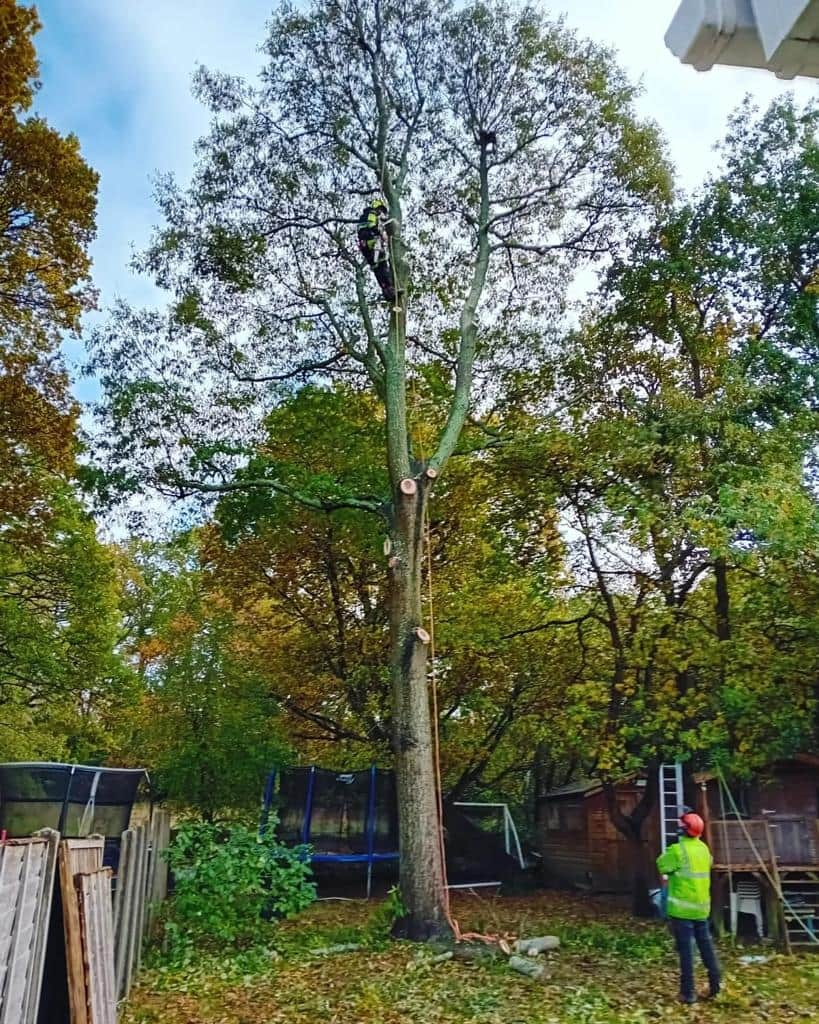
Removing a tree does not always mean the work is complete. Once the trunk and branches have been taken away, the remaining stump can continue to affect the surrounding garden or property. Old tree stumps can become obstacles, interfere with future landscaping and gradually deteriorate over time.
For homeowners and property owners in Malmesbury, Gloucestershire, stump grinding provides an effective way to deal with unwanted stumps and reclaim usable outdoor space. Understanding how the process works and why stump removal matters can help you decide when professional tree surgery may be appropriate.
What Is Stump Grinding?
Stump grinding involves using specialist machinery to mechanically reduce a tree stump below the surrounding ground level. The cutting equipment breaks the stump and major surface roots into wood material, allowing the remaining area to be cleared or prepared for future use.
Unlike simply cutting a stump closer to the ground, grinding removes a significant portion of the remaining wood. The depth required depends on the location, size and intended use of the area.
Professional stump grinding is particularly useful where leaving the stump in place would create an ongoing obstruction.
Why Should Old Tree Stumps Be Removed?
An old stump can create several practical problems around a property. Even when it is no longer attached to a living tree, the remaining wood can take considerable time to break down naturally.
A stump may become an obstacle when mowing the lawn, maintaining borders or moving equipment through the garden. It can also make it harder to redesign the surrounding area.
Removing the stump creates a cleaner, more manageable space and gives homeowners greater flexibility when planning future landscaping.
Old Stumps Can Attract Unwanted Pests
As a stump decays, the rotting wood can provide a suitable environment for various insects and other organisms. While the presence of insects does not automatically mean there is a serious problem, a deteriorating stump can become an unwanted feature close to lawns, planting areas or buildings.
Grinding removes much of the decaying wood from the surface, reducing the amount of material left behind to deteriorate naturally.
Stumps Can Interfere with Landscaping
An unwanted stump can limit what you can do with a garden. It may prevent new planting, interfere with lawn maintenance or restrict the layout of paths, patios and other outdoor features.
Grinding the stump can make the area easier to work with. Once the remaining material has been cleared and the ground prepared, the space can be incorporated into a wider landscaping project.
This makes stump removal particularly useful when an existing garden is being redesigned.
Can Tree Stumps Grow Back?
Some tree species can produce new growth from remaining roots or the stump itself. Simply cutting a stump down does not necessarily prevent regrowth.
Professional grinding removes much of the visible stump and reduces the remaining material. However, the potential for regrowth depends on the tree species, its condition and the extent of the remaining root system.
A professional assessment can help determine the most suitable approach for the particular stump.
What Happens During Professional Stump Grinding?
Before grinding begins, the stump and its immediate surroundings should be assessed. The operator needs to consider the stump’s size, position, surrounding ground and any potential obstacles.
The grinding machine is then used to reduce the stump in controlled stages. The resulting wood material is cleared or managed according to how the area is intended to be used afterwards.
Professional equipment allows the work to be carried out efficiently while keeping the operation focused on the specific stump and surrounding area.
When Is Stump Grinding Particularly Useful?
Stump grinding can be useful when a tree has already been removed but the remaining stump is causing an obstruction. It may also be appropriate where a garden is being renovated or where additional usable ground is required.
Signs that a stump may need attention include:
- It is obstructing lawn maintenance.
- It is preventing new planting.
- It is interfering with planned landscaping.
- It is becoming soft or decayed.
- New growth is appearing around the stump.
- It presents an unnecessary trip hazard in a frequently used area.
The most suitable solution depends on the stump’s condition, position and the plans for the surrounding space.
Stump Grinding in Malmesbury, Gloucestershire
For homeowners and property owners in Malmesbury, Gloucestershire, EM Tree Surgery Malmesbury provides professional stump grinding to help remove unwanted tree stumps and improve the usability of outdoor areas.
If you have an old stump that is restricting your garden or you are planning changes to an area where a tree has previously been removed, contact EM Tree Surgery Malmesbury to discuss the stump and arrange a professional assessment.
Conclusion
An old tree stump can remain an obstacle long after a tree has been removed. It can interfere with garden maintenance, restrict landscaping options and gradually deteriorate as it breaks down.
Stump grinding offers a practical way to remove much of the remaining stump and make the surrounding area easier to manage. For properties in Malmesbury, Gloucestershire, professional stump grinding can be a useful final step after tree removal or as part of a wider garden improvement project.
Call us on: 01666 337 167
Click here to find out more about EM Tree Surgery Malmesbury
Click here to complete our contact form and see how we can help with your tree needs.