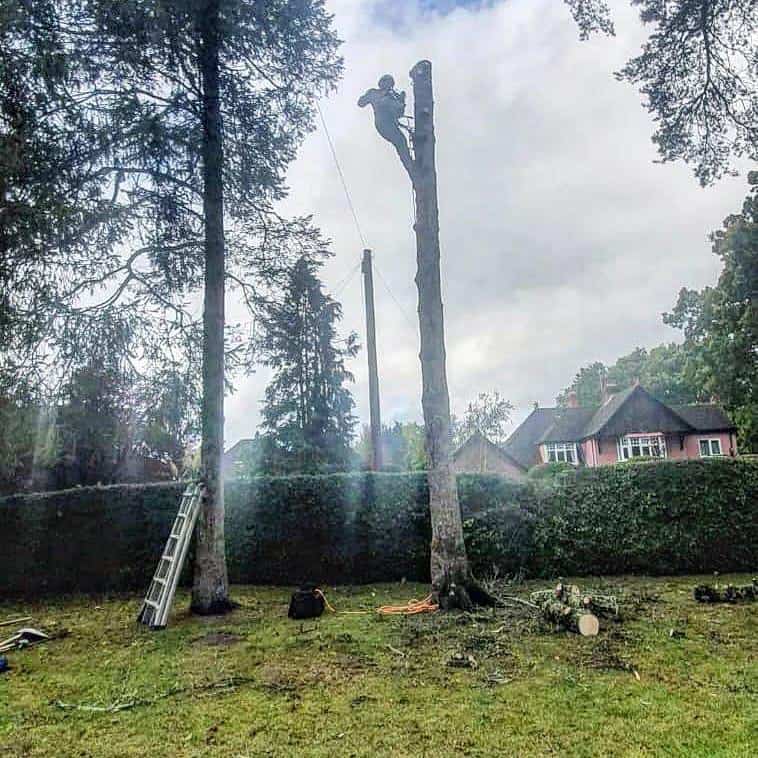
An overgrown garden rarely has just one issue. A tree may have developed an excessively large crown, neighbouring branches may be competing for space, deadwood may have accumulated, hedges can become difficult to manage, and old stumps may prevent parts of the garden from being used effectively. When these problems develop gradually, it is easy to approach each one separately rather than considering how they affect the garden as a whole.
For property owners in Malmesbury, Gloucestershire, one professionally planned tree surgery visit can often address several related problems at the same time. The key is to assess the complete garden first, prioritise the work correctly and choose appropriate tree surgery techniques for each tree or area rather than simply cutting everything back.
How One Tree Surgery Visit Can Improve Several Areas of an Overgrown Garden
A coordinated approach to tree surgery can be particularly useful when several trees, hedges or stumps require attention.
Instead of treating every issue as an unrelated task, a tree surgeon can assess how the different elements interact. One tree may be creating excessive shade, another may contain unsuitable branches, while an overgrown hedge could be reducing usable garden space.
By considering these problems together, the work can be planned to create a more balanced and manageable outdoor environment.
Overgrown Tree Crowns Can Be Managed
Trees can gradually occupy much more space than homeowners realise.
Branches may spread across lawns, patios and paths, while the crown can become increasingly dominant within the garden. Where appropriate for the individual tree, crown reduction can help manage its overall dimensions.
The aim is not simply to cut branches back as far as possible. Professional crown reduction considers the natural structure of the tree and selects suitable pruning points to achieve a controlled reduction.
Where several trees have become oversized, they can be assessed individually during the same visit so that each receives the type and amount of work it actually requires.
Dense Crowns Can Be Addressed Separately From Excessive Size
A tree can feel overgrown without necessarily being too large.
In some cases, the main issue is excessive density within the crown. A congested canopy can make the tree visually heavy and contribute to excessive shading within parts of the garden.
Where appropriate, selective crown thinning may help by removing suitable branches throughout the canopy while broadly retaining its overall dimensions.
This is different from crown reduction, which concentrates on reducing overall size.
A professional assessment can distinguish between the two so that unnecessary pruning is avoided.
Deadwood Can Be Removed During Other Pruning Work
Overgrown trees may contain dead branches that are not immediately obvious from ground level.
Where deadwood is identified during an assessment, its removal can often be incorporated into wider pruning work.
This means a visit originally prompted by excessive growth can also improve the condition of the crown by dealing with dead or unsuitable branches at the same time.
Combining related work allows the tree to be considered comprehensively rather than focusing exclusively on the branches that appear most inconvenient.
Crossing and Competing Branches Can Be Assessed
As crowns develop, branches can sometimes cross, rub or compete for the same space.
Simply shortening the outside of an overgrown tree does not necessarily address these internal structural issues.
Selective pruning can target appropriate branches where intervention is beneficial, helping create a more considered crown structure.
This is one of the advantages of professional tree surgery. The work can respond to several aspects of the tree’s condition rather than treating excessive size as the only concern.
Excessive Shade Can Often Be Improved
Large or dense trees can significantly influence the amount of natural light reaching a garden.
The correct response depends on why the shade has become excessive.
If the overall crown has grown too large, an appropriate reduction may improve the situation. If density is the main issue, selective thinning could be considered. Sometimes particular branches are primarily responsible and can be addressed without carrying out extensive work elsewhere.
Assessing all relevant trees together can also prevent too much work being concentrated on one tree when several crowns contribute to the shading.
Branches Encroaching on Usable Garden Space Can Be Addressed
Low or spreading branches can gradually reduce the amount of garden that feels comfortable to use.
They may extend across paths, seating areas, lawns or other practical spaces. In a heavily overgrown garden, several trees can contribute to this problem simultaneously.
Selective pruning can help restore appropriate clearance where suitable while retaining the wider tree.
Considering how people actually move through and use the garden helps ensure pruning has a practical purpose rather than being undertaken simply to make trees look smaller.
Hedge Cutting Can Restore Clearer Boundaries
Overgrown hedges can make an already crowded garden feel considerably more restricted.
They may become too wide, extend into paths or lawn areas and reduce the definition between different parts of the garden.
Where hedge cutting forms part of the required work, it can often be coordinated with tree surgery so that the complete garden is considered together.
Restoring a more manageable hedge shape can improve usable space and make the effect of surrounding tree work more noticeable.
Old Stumps Can Be Dealt With as Part of the Wider Improvement
A garden can remain awkward even after overgrown trees have been managed if old stumps continue occupying useful areas.
Stumps can interrupt lawns, restrict landscaping possibilities and make certain sections difficult to use.
Where suitable, stump grinding can address these remnants as part of a broader tree surgery visit.
This can be particularly useful where the objective is not merely to prune trees but to make an overgrown garden more practical overall.
Several Trees Do Not Necessarily Need the Same Treatment
One of the biggest mistakes when tackling an overgrown garden is assuming that every tree should simply be reduced.
Different trees may require entirely different approaches.
During the same visit, one tree might benefit from crown reduction, another from selective pruning, while another may only require deadwood removal. A tree that is already well balanced may not require intervention at all.
Matching the work to each individual tree helps avoid unnecessary pruning and produces a more considered result across the garden.
One Visit Can Help Create Better Balance Between Trees
Trees do not exist independently within a garden.
Several mature crowns may overlap visually or physically, and reducing one without considering neighbouring trees can sometimes make the overall garden feel unbalanced.
Assessing them together allows the relationship between individual crowns to be considered.
The objective can then become improving the garden as a whole rather than simply reducing each tree by an arbitrary amount.
Tree Surgery Can Help Recover Usable Garden Space
An overgrown garden can feel smaller than it really is.
Wide hedges, low branches, unmanaged crowns and old stumps can gradually occupy areas that were previously accessible. The result can be narrow paths, restricted lawns and outdoor spaces that feel dominated by vegetation.
Carefully planned tree surgery can help recover some of this space.
This does not require removing every mature feature. Often, selective management is enough to improve clearance and make the garden feel considerably more usable.
The Work Should Be Prioritised Before It Begins
Even when several issues can be addressed during one visit, the work should still follow a clear plan.
The most important tasks should be identified first. These might include dead or damaged branches, particularly problematic growth or trees requiring more careful structural attention.
General size management, hedge cutting and stump work can then be considered within the wider programme.
Prioritisation prevents the visit from becoming a collection of unrelated cutting tasks and ensures that each part of the work contributes to the overall improvement.
Avoid Over-Pruning in an Attempt to Solve Everything at Once
A single visit can achieve a great deal, but that does not mean every tree should undergo extensive pruning at the same time.
Removing excessive amounts of growth can compromise natural form and may encourage undesirable regrowth in some trees.
Good tree surgery is selective.
Where lighter intervention is appropriate, there is no advantage in carrying out more work simply because other areas of the garden are also being addressed.
The aim should be to complete the necessary work while retaining suitable growth wherever possible.
Some Gardens Benefit From Ongoing Management
One tree surgery visit can resolve many existing problems, but trees and hedges will continue growing afterwards.
Where a garden contains several vigorous trees or fast-growing hedges, periodic management may help prevent the same level of overgrowth from returning.
This does not necessarily mean repeating exactly the same work each time.
Future visits can respond to how individual trees have developed, allowing smaller and more selective interventions where appropriate.
Professional Assessment Helps Identify What Actually Needs Doing
When a garden has become heavily overgrown, it can be difficult to decide where to begin.
At EM Tree Surgery Malmesbury, we assess trees and related vegetation in Malmesbury, Gloucestershire by considering the condition of individual trees alongside the way they affect the wider garden.
This allows appropriate work such as crown reduction, selective pruning, deadwood removal, hedge cutting or stump grinding to be considered together where required.
The purpose is not to carry out as much tree surgery as possible, but to identify which combination of work will provide a meaningful improvement while avoiding unnecessary intervention.
Conclusion
Yes, one carefully planned tree surgery visit can often solve several problems in an overgrown garden. Oversized crowns, excessive density, deadwood, intrusive branches, overgrown hedges and unwanted stumps can potentially be addressed as part of a coordinated programme of work.
The most effective approach is to assess the garden as a whole while still treating every tree individually. This helps ensure that each task has a clear purpose and that unnecessary pruning is avoided.
If your garden in Malmesbury, Gloucestershire has become difficult to manage because of overgrown trees, hedges or old stumps, contact EM Tree Surgery Malmesbury. We can assess the existing growth and recommend an appropriate combination of tree surgery services to help create a more balanced and manageable outdoor space.
Call us on: 01666 337 167
Click here to find out more about EM Tree Surgery Malmesbury
Click here to complete our contact form and see how we can help with your tree needs.